Teachings & philosophy
A Shankaracharya does not found a new teaching. He hands on an old one. This page sets out the tradition he represents and, separately, what he has said in public.
DocumentedReported statements or actions of Swami Sadanand Saraswati, with a source.
TraditionTeachings of the Advaita and Dashanami tradition that his office carries. These are not personal claims.
EditorialOur own explanation, written to help general readers.
Advaita Vedanta: the teaching of non-duality
अद्वैत वेदान्त
Advaita means “not two”. As systematised by Adi Shankaracharya, Advaita Vedanta holds that Brahman, pure consciousness and being, is the only ultimate reality. It holds that the innermost Self of each person, the atman, is not different from Brahman. The world of many separate things is not simply denied. It is treated as appearance (maya), real at the level of everyday experience but not at the ultimate level.
In this view, the root of human bondage is ignorance (avidya): mistaking oneself for the body, the mind and their roles. Liberation (moksha) is not a new state to be produced. It is the removal of that ignorance through knowledge (jnana). That knowledge is gained by hearing the scriptures from a qualified teacher (shravana), reflecting on them (manana) and contemplating them deeply (nididhyasana).
The four amnaya seats were set up, according to tradition, to protect and teach exactly this. Whoever heads the Dwarka Sharada Peetham inherits the duty of teaching Advaita. That is why the philosophy belongs on this page, even though it is not his personal invention.
ब्रह्मन्
Brahman
The one reality: being, consciousness, limitless.
आत्मन्
Atman
The Self: the witnessing consciousness in each being, identical with Brahman.
माया
Maya
The power of appearance by which the one seems to be many.
मोक्ष
Moksha
Freedom: the end of ignorance about one's own nature.
Tat Tvam Asi, the saying entrusted to Dwarka
तत्त्वमसि · छान्दोग्य उपनिषद् ६.८.७
Each of the four seats is traditionally tied to one Veda and one mahavakya (“great saying”) from it. Dwarka's Veda is the Sama Veda. Its saying is Tat tvam asi, “That thou art”, from the sixth chapter of the Chandogya Upanishad.
In the Upanishad, the teacher Uddalaka Aruni instructs his son Shvetaketu, who has come home proud of his learning. Uddalaka uses a series of homely images: salt dissolved in water, which cannot be seen but is tasted everywhere; the tiny seed of the banyan, which holds the whole tree; rivers that lose their names in the sea. Each time he ends with the same refrain. The subtle essence that pervades everything is the truth, it is the Self, and that thou art.
In Shankara's reading, the sentence does not mean that a small individual equals a great God. It means that when the limiting ideas attached to “you” (a body, a mind, a history) and to “That” (an all-powerful cause) are set aside, what remains in both is the same consciousness. A teacher in the Dwarka line is, in principle, a custodian of this one sentence and its explanation.
Dwarka (west): Tat tvam asi
Sringeri (south): Aham brahmasmi
Puri (east): Prajnanam brahma
Jyotirmath (north): Ayam atma brahma
Guru and disciple: knowledge passed from person to person
गुरु–शिष्य परम्परा
Advaita teaches that self-knowledge comes through a teacher who has received it from his own teacher. The Mundaka Upanishad tells the seeker to go “with fuel in hand” to a guru who is learned in scripture and established in Brahman. The four seats exist to keep this chain (parampara) unbroken.
What his own life documents Documented
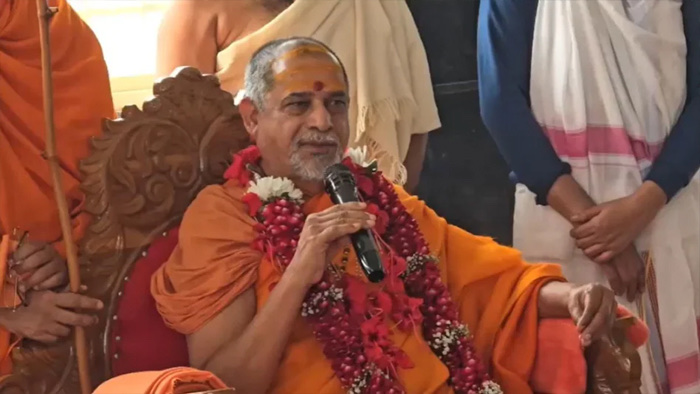
His own biography is a clear example of this ideal. News reports agree that he came to Swami Swaroopanand Saraswati's ashram as a youth, took brahmachari initiation from him, and later received dandi sannyas from him in Varanasi. He then served as the guru's representative at Dwarka. On 12 September 2022 he was named his guru's successor at the ashram where the guru had just been laid to rest. By these accounts, a single relationship ran through more than five decades of his life.
Renunciation, the staff and the ten names
दशनामी · दण्डी संन्यास
Tradition credits Shankara with organising the monks of his line into the Dashanami, the order of “ten names”: Giri, Puri, Bharati, Vana, Aranya, Parvata, Sagara, Tirtha, Ashrama and Saraswati. Each name is traditionally linked to one of the four seats. “Saraswati”, the name Sadanand carries, is one of them.
Within the order, dandi sannyasis are the renunciants who carry a wooden staff (danda). The staff stands for the discipline of body, speech and mind. It is usually held by monks of the Tirtha, Ashrama and Saraswati branches, and Shankaracharyas are chosen from among them. Sadanand's dandi sannyas, reported as 2003, placed him in the pool from which a successor could be drawn.
The Advaita case for renunciation is not that the world is bad. It is that complete dedication to self-knowledge is easier without the ties of household life. The tradition also has room for householders, who follow dharma in their daily duties and study the same scriptures.
The staff, the ochre cloth, the rudraksha beads and the horizontal lines on the forehead appear in most of the photographs of him on this site.
The Bhagavad Gita and the monsoon retreat
चातुर्मास्य
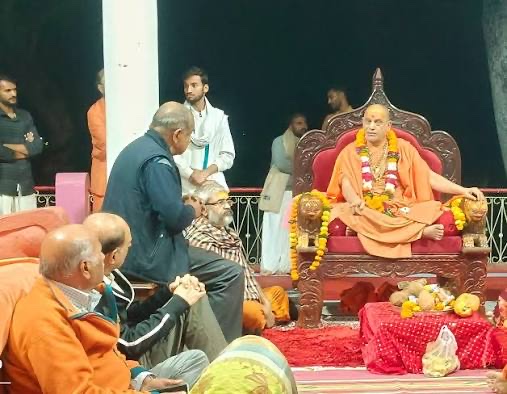
Sannyasis traditionally stop travelling during the four monsoon months, the chaturmasya or chaturmas, often counted from Guru Purnima. They stay in one place and teach. For a Shankaracharya this is the longest sustained teaching period of the year.
Documented: text on the Peetham-linked website records his chaturmas from 3 July to 29 September 2023 at Sharada Peeth, Dwarka, with discourses on the Bhagavad Gita. We could not find published details of later chaturmas.
Editorial: the choice of text fits. The Gita is one of the three foundations of Vedanta. Shankara wrote a commentary on it that is still studied in every Math of his line. Its theme of acting without attachment to results, while knowing the Self as untouched by action, speaks to renunciants and householders alike.
Public positions since 2022
धर्म, गौ, संस्कृत
Everything in this chapter is drawn from dated news reports. Quotations appear only where a named outlet reported the words directly. Translations from Hindi are our own and marked as such.
Religious teachers and political power
Speaking at Piparia in Madhya Pradesh in February 2026, he drew a line between spiritual authority and political alignment. ETV Bharat reported his words:
“जो धर्मगुरु दो धड़ों में बट रहे हैं, वो धर्मगुरु हैं ही नहीं, वो सत्ता के गुरु हैं।”
In the same report he is quoted as saying, “हम लोग जो बोलेंगे वह देश के पक्ष में, धर्म के पक्ष में… बोलेंगे”. In our translation: “Whatever we say, we will say in favour of the nation and of dharma.” He also criticised the absence of teaching about Sanatana Dharma in education.
Cow protection
He has consistently supported a ban on cow slaughter. At the Prayagraj Maha Kumbh on 29 January 2025, he and the Shankaracharyas of Sringeri and Jyotirmath issued a joint 27-point Dharmadesh. According to India TV, it included a demand to ban cow slaughter and to declare the cow the “Mother of the Nation”. In February 2026 he said that all four Shankaracharyas agree on protecting the cow (ETV Bharat).
Sanskrit
At the same Kumbh gathering he stressed the importance of Sanskrit (India TV, 29 January 2025). The emphasis matches his own training, which began with Sanskrit at his guru's ashram.
The Ayodhya consecration, January 2024
Before the Ram temple consecration on 22 January 2024 there was widespread comment about the Shankaracharyas' absence. He told India TV on 15 January:
“None of the Shankaracharyas are angry. We are not going to the function due to arrangements that have been made at the event.”
ANI, reporting from Ahmedabad on 20 January 2024, described him welcoming the consecration as a moment that had come after roughly four to five hundred years.
Hindus in Bangladesh
On 19 August 2024 he told Republic: “The governments of India and Bangladesh should sit down and discuss the situation of Hindus.”
A note on attribution. News reports sometimes mix up the statements of the different Shankaracharyas, especially the two acharyas named on the same day in 2022. For example, a widely reported claim in July 2024 about gold at Kedarnath came from the Jyotirmath Shankaracharya, not from Swami Sadanand Saraswati. This page includes only statements attributed to him by name.
Reading the tradition and the statements together
Two layers run through his public life. One is the old, abstract philosophy of the seat: Tat tvam asi, the identity of the Self with the absolute. The other is concrete and often topical: the cow, Sanskrit, the Ram temple, the safety of Hindus abroad, the independence of religious leaders from politics.
Within the tradition these are not in tension. A Shankaracharya is expected both to teach the highest knowledge and to speak as a guardian of dharma, the order of duty and practice that prepares a person for that knowledge. The Bhagavad Gita, which he chose for his 2023 chaturmas, is the classic text that joins the two. It teaches action in the world and knowledge of the Self as one discipline.
Readers who want his teaching in his own words should go first to his spoken discourses, which are in Hindi. Summaries in the press, including those quoted here, cover only the parts that made news.
Sources
- Chandogya Upanishad 6.8–6.16 (Uddalaka and Shvetaketu); Mundaka Upanishad 1.2.12.
- Wikipedia, “Dwarka Sharada Peetham”. wikipedia.org
- Sringeri Sharada Peetham, “Amnaya Peethams”. sringeri.net
- Wikipedia, “Chaturmasya”. wikipedia.org
- ETV Bharat (Hindi), Piparia, 13 Feb 2026. etvbharat.com
- India TV, joint Dharmadesh, 29 Jan 2025. indiatvnews.com
- India TV, interview, 15 Jan 2024. indiatvnews.com
- ANI via WebIndia123, 20 Jan 2024. webindia123.com
- Republic, 19 Aug 2024. republicworld.com
- India TV, Kedarnath gold claim attributed to the Jyotirmath Shankaracharya, 15 Jul 2024. indiatvnews.com