॥ Four stages, one teacher
From shishya to Shankaracharya
A monk's life is measured by initiations, not by birthdays. Each stage below is one step in a single lifelong apprenticeship, and each was received from the same guru.
Stage I · from c.1970
शिष्य
Śiṣya: the one who is taught
A boy from Bargi comes to Jhoteshwar
The journey begins with a crossing that is short on a map but large in meaning: from the village of Bargi to the Paramhansi Ganga Ashram at Jhoteshwar, both in Narsinghpur district. Ramesh Awasthi arrived there as a youth. The most detailed account, in Patrika, puts it in 1970, when he was about twelve and had just left school. Other reports say eighteen.
Whatever his exact age, the first discipline was the same: Sanskrit. In the traditional course, the language comes before the philosophy, because the scriptures and Shankara's commentaries cannot be understood second-hand. A student at this stage lives in the ashram, serves, memorises and listens.
Stage II · 1970s to 1980s
ब्रह्मचारी
Brahmacārī: one who walks in Brahman
Initiation as Brahmachari Sadanand
From Swami Swaroopanand Saraswati he received brahmachari diksha and a new name, Brahmachari Sadanand. Several outlets confirm the initiation. None gives its year. The name, “ever-blissful”, is the one he still carries.
These were years of building, in stone and in learning. Patrika reports that he was at Jhoteshwar through the construction of the ashram's Tripura Sundari temple (1975–82). He then studied the shastras in Varanasi for about eight years. In 1982 his guru took charge of the Dwarka Sharada Peetham, and the western seat entered his horizon.
Stage III · 1995 to 2022
दण्डी
Daṇḍī: the bearer of the staff
The staff, and a seat to look after
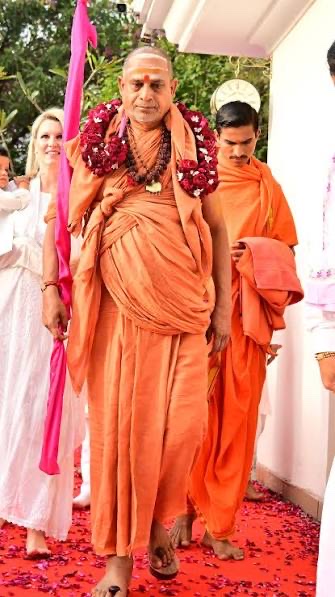
Responsibility came before the final renunciation. From 1995, according to Patrika, he served as the Shankaracharya's representative at Dwarka. Several reports confirm the role. For a guru who also headed Jyotirmath and lived largely in Madhya Pradesh, it meant a trusted disciple in residence at the western seat.
Then, in Varanasi, he received dandi sannyas from his guru and became Dandi Swami Sadanand Saraswati. Patrika dates this to 2003. Taking sannyas, a monk renounces not only possessions but his social standing itself. The danda he now carried is the mark of the monks from among whom Shankaracharyas are chosen. In 2022 PTI described him as the guru's “second-in-command”.
Stage IV · from 2022
आचार्य
Ācārya: one who teaches by conduct
Jagadguru Shankaracharya of Dwarka
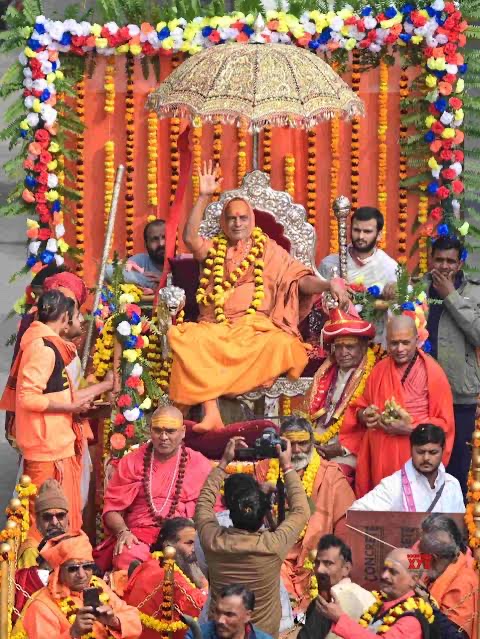
On 11 September 2022 Swami Swaroopanand Saraswati died at Jhoteshwar. The next day, after his guru's bhu-samadhi, the succession was announced at the same ashram. Swami Sadanand Saraswati would head the Dwarka Sharada Peetham. His guru had brought him to that seat as a representative almost thirty years earlier.
Recognition followed from within the order. A Dainik Bhaskar report, republished online, describes a consecration at Sringeri on 28 September 2022. Gujarat Samachar reported his enthronement at Dwarka in mid-October 2022. Since then the stage of the teacher has meant chaturmas discourses on the Bhagavad Gita, Dharma Sabhas in Gujarat, the Maha Kumbh at Prayagraj in 2025, and public statements on dharma.
In the tradition, an ācārya is one who teaches by conduct. He practises what he teaches and establishes others in it. The word carries a demand as well as an honour.
Sources
- Patrika, profile, 18 Sep 2022. patrika.com
- ETV Bharat (Hindi), 12 Sep 2022. etvbharat.com
- PTI via ThePrint, 12 Sep 2022. theprint.in
- Advaita-L archive (Dainik Bhaskar repost), Sringeri consecration. advaita-vedanta.org
- Gujarat Samachar, 14 Oct 2022. gujaratsamachar.com
- Katha Upanishad 1.2.1–2 (the good and the pleasant).